What Cronus is today
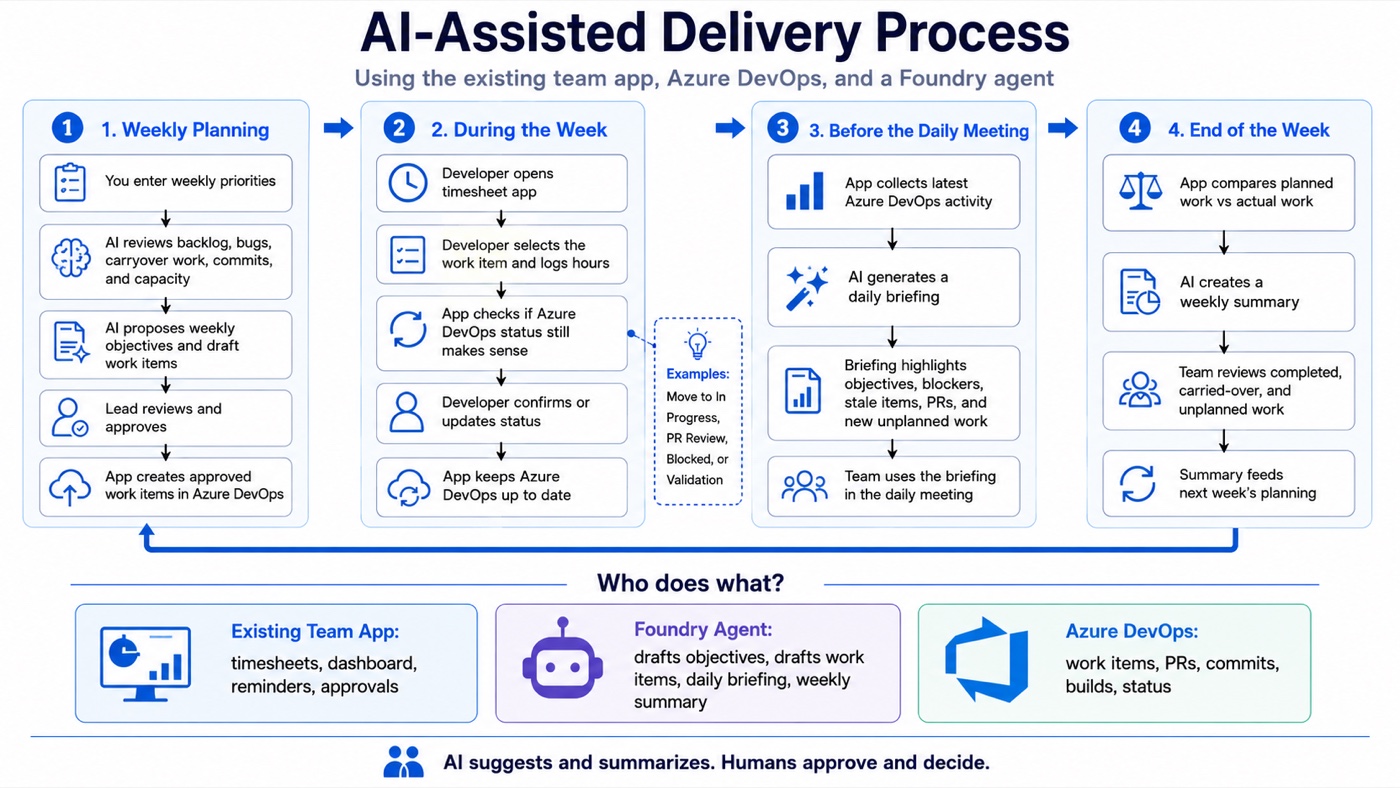
Cronus is an operating layer around Azure DevOps, not a new delivery portal. Azure DevOps remains the source of truth for the work. Cronus gives specialized agents controlled access to that context and surrounds them with reusable engineering guidance.
The objective is not to add a chatbot to the development process. It is to redesign the workflow so that AI participates at the four points where a team actually loses time: interpreting incoming requests, collecting status, preparing the daily meeting, and reconstructing what happened during the week.
Four narrow agents cover those points. Refiner turns an informal request into the smallest useful set of work-item drafts. Monitor produces an evidence-based briefing before the daily meeting. Planner proposes a realistic weekly plan from priorities, carryover, and current risk. Insights explains what actually happened and where the week lost time.
None of them writes to Azure DevOps. Three read it, and Refiner needs no connection to it at all. Approved actions are executed by the application, not by the agent that proposed them. That separation is why the model can be given real delivery data in the first place.
On a Monday morning, an engineer still opens the normal sprint and work items. Before stand-up, Monitor turns the current state into a concise delivery picture. When a story is selected, Refiner can identify ambiguity and propose stronger acceptance criteria. The team reviews those recommendations before the work changes. The intelligence comes to the workflow instead of creating another place to maintain.
Individual speed is not organizational capability
When every engineer develops a private way of using AI, the organization may gain speed without gaining capability. Useful context stays on laptops. Effective instructions remain personal technique. Review quality depends on who happened to do the work.
That model does not scale. A team needs shared context and reusable methods that improve the next delivery, not only the current one. Otherwise AI accelerates the same inconsistencies the organization already had.
A general-purpose assistant can help an individual answer a question. Cronus is aimed at the repeated work around delivery: understanding the same backlog, applying the same standards, and making the result visible to the team. The distinction is shared operating context.
Keep the delivery system as the source of truth
Cronus does not ask a team to copy requirements into a separate AI workspace. Agents operate from the work items that already contain priorities and acceptance criteria. That keeps AI assistance anchored to the same commitments the team reviews.
This is more than a convenience. Parallel systems create parallel truths. Once status, scope, or decisions drift, the agent becomes another participant working from incomplete information. AI adoption should reduce process friction, not manufacture a second process.
Build responsibilities, not one powerful agent
Cronus is a set of narrow responsibilities rather than one autonomous delivery agent. Each has a defined purpose, its own access, and a different kind of output. That is what keeps it reviewable: when a briefing is wrong there is one agent to correct, not a general-purpose assistant to re-prompt.
- Refiner: turn an informal request into the smallest useful set of work-item drafts
- Monitor: produce an evidence-based briefing before the daily meeting
- Planner: propose realistic weekly objectives from priorities, carryover, and risk
- Insights: explain what happened during the week and where to improve next
The reusable asset is engineering judgment
The purpose of Cronus is not to collect clever prompts. It is to turn engineering judgment into assets the team can inspect and improve. A reusable skill can encode how the team refines a story or reviews a change. Documentation supplies the architectural context that should not depend on memory.
Those assets need ownership and versioning. When a review standard changes, the team should be able to see what changed and evaluate the effect. A private prompt cannot provide that discipline. A shared skill can.
Standardization stops where judgment becomes consequential. People still prioritize the work, approve architecture, accept exceptions, and own the release. Cronus should make those decisions better informed, not less human.
That boundary is important. Automating a weak standard makes inconsistency faster. Capturing a strong standard makes the whole team better.
From an operational slice to a delivery system
The rollout is phased, and each phase has to earn the next. The first improves coordination: Refiner drafts work items from informal requests, Monitor produces the daily briefing, and the team establishes a baseline it can measure against.
The second improves process discipline. Time is associated with work items, one-click confirmations replace status collection, and stale statuses and ownership gaps become visible instead of anecdotal. None of that is glamorous. It is what makes the third phase possible.
The third improves predictability. Planner proposes weekly objectives; Insights measures carryover, unplanned work, and where the week actually went. Carryover rate, unplanned-work percentage, and ready work-item rate are the numbers worth watching. The first objective is not to optimize them. It is to keep the delivery system consistent enough that they can be trusted at all.
The success criterion is not that we built AI agents. It is that the team can absorb a change in priorities without losing visibility, quality, or delivery discipline.
AI-first engineering becomes durable when the organization can teach its methods, measure their effect, and revise them deliberately. Cronus is designed to make AI assistance a property of the delivery system—not a private advantage held by a few engineers.